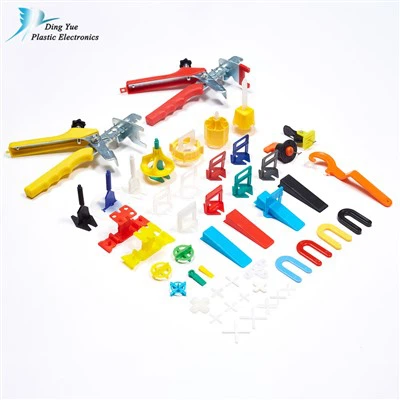
1. Advantages of mould: high production efficiency, good quality, low cost, saving energy and raw materials
2. Mold material is an important factor affecting mold life, quality, production efficiency and production cost
3. Heat treatment is an effective measure to improve the strength, toughness and surface properties of die steel and to give full play to the potential of die steel.
4. The standardization of mould is an important symbol of the development of mould industry and mould technology
5. The development of mould CAD/CAM technology has greatly promoted the development of mould manufacturing technology
6. To improve the strength, rigidity and toughness of the mold matrix, heat treatment processes such as tissue pretreatment, high quenching and low tempering, low quenching and low tempering, and low temperature rapid annealing should be used.
7. To improve the surface strengthening of the mold, chemical heat treatment, metal infiltration, chemical deposition, electroplating, coating and electric spark strengthening should be used.
8. Common heat treatment processes for die parts: annealing, normalizing, quenching and tempering, aging, quenching, tempering, carburizing and desalting, etc.
9. Mould processing procedure: refers to the process documents that stipulate the machining process and operation methods of mould parts and components.
10. Compared with the mechanical processing of other mechanical products, the mechanical processing of moulds has its particularity: moulds → single piece and small batch production, mould standard room → batch production. Forming parts → High machining accuracy
SEE MORE →
11. Good manufacturability of part structure means that the structure and shape of the part can be processed conveniently and economically according to the existing production conditions on the premise of meeting the use requirements.
12. Technical requirements for parts include: dimensional accuracy of main processing surfaces, geometric accuracy of main processing surfaces, mutual positional accuracy between main processing surfaces, surface quality of parts, material and heat treatment requirements of parts and other requirements
13. The blank forms of die parts are mainly divided into four types: original profiles, forged parts, cast parts and semi-finished parts
14. Forms of mold working surface damage: friction damage, plastic deformation, cracking, fatigue damage, gnawing, etc.
15. mold production cycle: the time taken to deliver qualified molds from the time when the mold ordering task is accepted to the time when the mold is tested and identified.
16. The main indicators for technical and economic analysis of moulds include: mould precision and surface quality, mould production cycle, mould production cost and mould life. They restrict and depend on each other.
17. Machining method for external surface of mould parts: Generally, general cutting machine tools are used for machining
18. The outer (convex) working face can be regarded as a generalized shaft and processed by the technological method of shaft parts. The inner (concave) working face can be divided into shaped holes and grooves, which are processed by the technological method of hole parts.
19. Coordinate boring machine is a high-precision hole processing machine, which is mainly used to process the fine-dense hole system on mold parts, because the holes it processes not only have higher dimensional and geometric accuracy, but also have higher hole pitch accuracy.
20. Forming grinding divides the contour line of parts into several straight lines and arcs, grinding them step by step according to a certain sequence to meet the technical requirements of drawings. Forming grinding can be divided into two types according to processing principles: forming grinding wheel grinding and fixture grinding.
SEE MORE →
21. Principle of grinding method with forming grinding wheel: firstly, the grinding wheel is trimmed to an opposite profile that completely matches the profile of the workpiece, and then the workpiece is ground with the grinding wheel to obtain the workpiece with the required size and technical requirements
22. The performance of pulse current directly affects the processing speed, surface quality, processing stability, tool electrode loss and other indicators
23. Die WEDM process is mainly divided into seven steps: pattern analysis, blank preparation, process preparation, programming, workpiece clamping, processing and inspection
24. Structural forms of electrodes: integral, inlaid and combined
25. Length of electrode: The precision of the tool electrode directly affects the precision of the female die. The dimensional precision of the tool electrode should be one level higher than that of the female die. The surface roughness shall be one level lower than that of the female die, and the parallelism and straightness shall be no more than 0.01mm in length at 100 mm.
26. Cross-sectional area dimension of electrode: The cross-sectional area dimension of electrode is to uniformly reduce a unit surface discharge gap δ according to the contour line of concave model hole. The dimension tolerance of electrode can be 1/2 and 1/3 of that of male model, and the surface roughness Ra is generally 0.8-1.6um
27. When the fit gap of the male and female dies is equal to the discharge gap, the electrode size and the male die size are exactly the same
28. When the fit clearance of the male and female dies is larger than the discharge clearance, the electrodes are increased by a value uniformly around the cross section of the male die.
29. When the fit clearance of the male and female dies is smaller than the discharge clearance, the electrodes are uniformly reduced by a value around the cross section of the male die.
30. Electrical regulation: refers to electrical parameters such as voltage, current, pulse width, intermittence, etc. in the EDM process